Transmission Control Protocol / Internet Protocol (TCP/IP) is a set of communication protocols which specify how data is transferred across networks (and therefore the internet). It can also be identified as the DoD (Department of Defense) model as it came out of a US communications project.
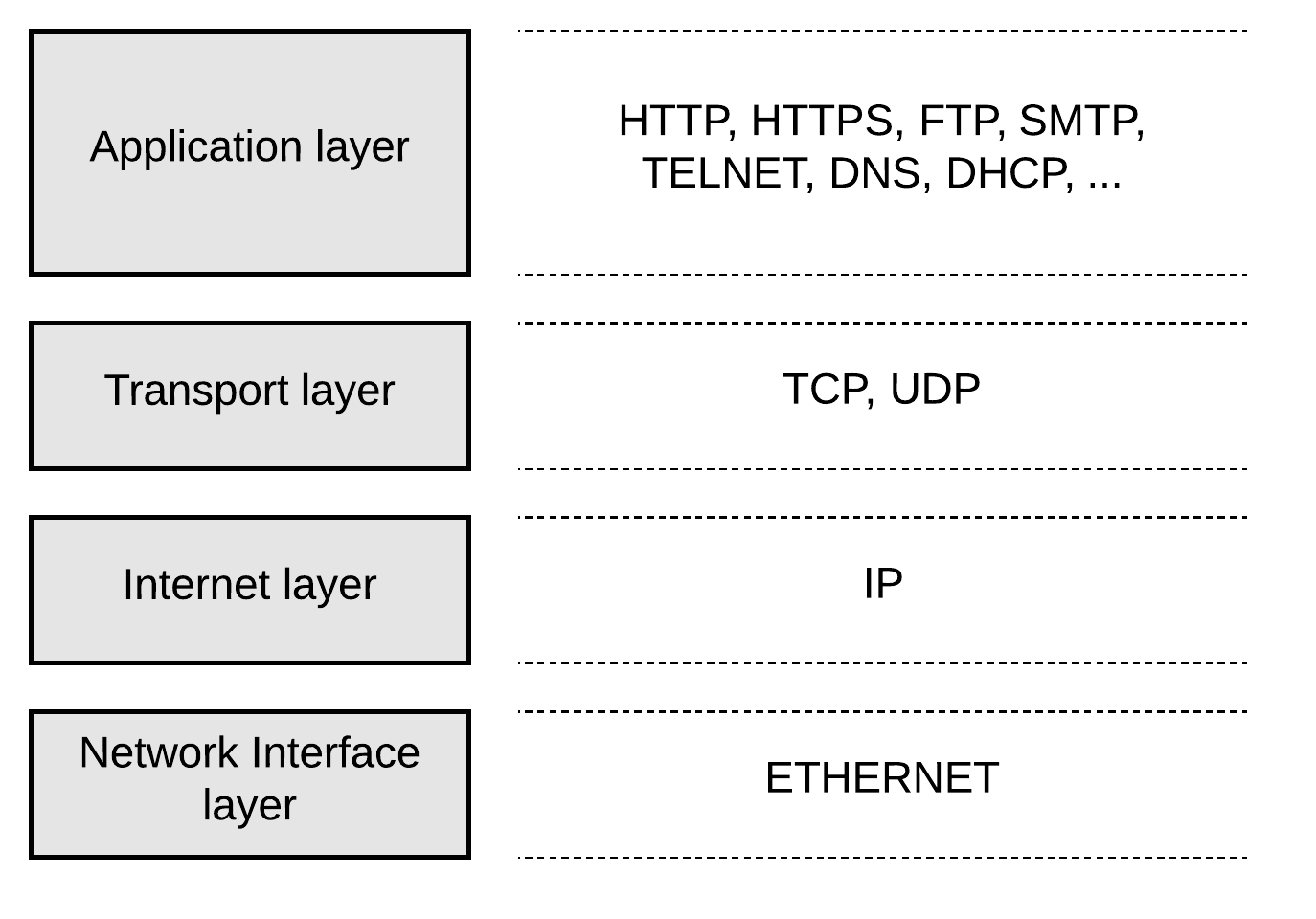
Data is assembled in packets, addressed, transmitted, and routed using TCP/IP. The model separates into four distinct layers – Application layer, Transport layer, Internet layer, and Network layer.
Packet switching allows data to be broken up into small packets and sent over multiple connections and reassembled when it reaches its destination. This means if any connections are lost during transmission a new route can be found with no loss of data.
Application layer
The application layer provides applications (Chrome, Outlook, etc) the means to exchange information. Common protocols used within this layer are HTTP (HyperText Transfer Protocol), FTP (File Transfer Protocol), SMTP (Simple Mail Transfer Protocol), DHCP (Dynamic Host Configuration Protocol) and many more. This layer sends and receives data from the transport layer – all layers in the TCP/IP model are dependent on the next.
Transport layer
The transport layer provides end to end session control of the application packets. It ensures all the packets are sent and received correctly by checking for errors, the order of the packets, duplication, and that any lost packets are resent. In this layer TCP and UDP are the two protocols used. TCP is a one-to-one protocol, whereas UDP (User Datagram Protocol) is a one-to-many protocol which does not check for lost packets and is only used in applications where errors are acceptable – video and VOIP (Voice Over IP) for example. TCP is used where data loss is unacceptable such as HTTP, SMTP, FTP, etc.
Internet layer
The internet layer provides connectionless routing for the transport layer. It deals with the addressing, identification, and routing of packets. When transferring data across the internet (and even local networks) it must travel across many routers, the internet layer deals with the network-to-network routing. This layer deals with IP addresses (IPv4 and IPv6).
Network layer
The network layer provides the physical access to networks, whether they be wireless, UTP (Unshielded Twisted Pair), fiber optic, etc. Each physical network has different requirements for access, format, and medium. For example fiber optic uses the medium of light, WiFi uses the medium or radio waves. The most common network interface protocol is ethernet. Like the internet layer, the network layer is connectionless and does not provide session control. The network transfers the packets from the layers above it in frames.