
These pieces of equipment are just some of the network components required to create computer communication networks. You need to know what they are and how they are used within a network topology. Topology refers to arrangement of network hardware and how they connect to each other.
They are connected using Transmission media (UTP, fibre-optic, and wireless).
Router
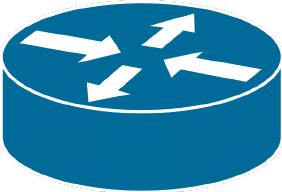
Connects multiple networks together and routes traffic between them, determining the best path/route for packets.
Routers forward packets of data along networks, they connect at least two networks (or subnets) together. Those networks can be Local Area Networks (LANs) or Wide Area Networks (WANs). They differ from switches by acting as gateways and as such have more complex rules to direct packets of data. They operate as a Level 3 gateway (the Internet layer (TCP/IP)).
Routers handle NAT (Network Address Translation) – They can translate public IP addresses to private IP addresses to allow internal hosts with private IPs to communicate externally.
Switch
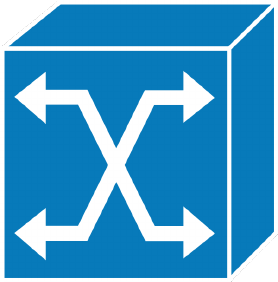
Connects devices on a Local Area Network (LAN) together by receiving packets and forwarding them to the correct destination device. Operates at the network layer of the TCP/IP model.
A switch filters and forwards packets within a Local Area Network (LAN), therefore, they only deal with local network traffic. They do not act as gateways between other LANs or WANs.
Switches maintain an ARP (Address Resolution Protocol) table (with MAC (Media Access Control) addresses) to identify the devices connected to them by linking their MAC address with the IP address provided by the DHCP server.
ARP is a protocol found in the Internet layer of the TCP/IP model.
Firewall

Monitors incoming and outgoing network traffic and blocks or allows it based on configured security rules. Protects internal networks from unauthorized access.
A firewall prevents unauthorised access to a network. Firewalls can be hardware, software, or both. You will likely have a firewall installed on your computer, but you may also have a firewall as part of your ADSL modem at home. In business environments, firewalls are usually dedicated pieces of equipment between the ISP (and the Internet) and the internal network, but individual workstations (PCs/Macs) and servers may still have software firewalls.
Firewalls inspect every packet entering and leaving the network to ensure they meet specified security criteria.
Modem (modulator/demodulator)
Modulates and demodulates signals to convert digital data to analog to transmit over telephone wire and vice versa. Connects a network to an Internet Service Provider (ISP). This includes ADSL.
Modem is short for modulator/demodulator. This means they convert digital signals to analogue and analogue to digital. They enable computers/networks to transmit data over telephone or cable lines (which are analogue, not digital). Dialup modems used to be common, but now DSL (ADSL) and Cable modems are most common. Fibre optic does not require modems as it is a digital transmission media.
Network Interface Card (NIC)
Hardware component that allows a device to connect to a wired or wireless network. Has a unique MAC address. Handles framing and physical addressing. Operates at the network layer of the TCP/IP model.
Often referred to as NIC, they allow computers and servers to connect to a network. Even smart phones, tablets (iPads/Android) have NICs, even though there is no wired connection they have wireless NICs. ALL network devices have NICs.
(Wireless) Access Point (WAP or AP)

Connects wireless devices together to create a wireless network. Allows wireless devices to connect to a wired network.
Within this course Access Points (APs) are referred to as Wireless Access Points (WAPs). APs provide a communication “hub” for wireless devices to connect to a wired LAN. Be aware WAP also has another meaning related to older mobile phones connecting to the internet (Wireless Application Protocol) – this has nothing to do with this definition as it relates to cellular connectivity which we cover elsewhere.
Gateway
Connection between networks that uses different protocols. Performs protocol translation and routing between the networks.
A network gateway allows networks with different protocols to communicate with each other. For example the Apple AirPlay uses a protocol called Bonjour, Bonjour does not natively work across multiple networks – a Gateway can solve this problem. Gateways are often on the edge of networks.
Each transmission media has a maximum distance it is reliable over, beyond these distances errors can occur due to signal loss (attentuation) or noise. Repeaters can solve this problem by boosting the signal at set distances. They are not common in most LANs. They offer no routing capability.