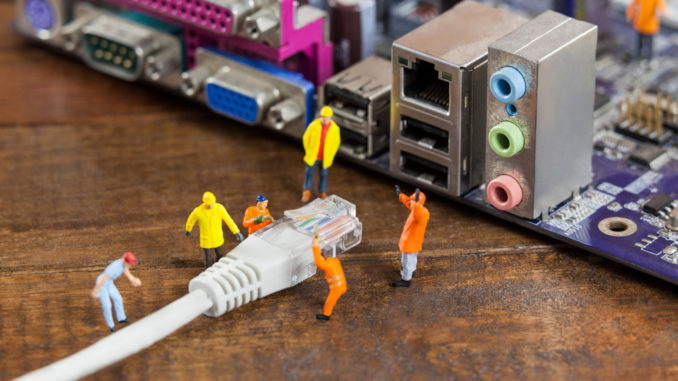
Transmission media (or medium) refers to any method of network connection, whether it is wired or wireless. They all transfer packets of data using different technologies.
Wired
UTP (Unshielded Twisted Pair)
UTP is often referred to as ethernet, CAT 5, CAT5e or CAT6 cables. Twisted pair contain 4 pairs of copper cable twisted around each other. The twist is to reduce inteference; shielded twisted pair (STP) has an additional shielding around all wires to help eliminate inteference. Interference can slow or stop the transmission of data (by corrupting the signal). Twisted pair are used to connect network devices to each other. CAT6 supports 1000Mbps (and up to 10Gbps over shorter runs), whereas CAT5e supports 100Mbps – but only upto 100 metres, the speed slows if the cable is longer than that – this is known as attenuation. They are often terminated with RJ45 connectors as pictured.
Mbps = mega bits per second. Data transfer rate is always measured in bits per second, not bytes. Mega = 1000, therefore 1000Mbps equals 1000,000 bits per second. 1000Mbps is sometimes shown as 1Gbps.
Be aware ethernet can travel over different types of cable (UTP, STP, Fiber, even HDMI) so do not use that term to reference twisted pair. The ethernet standard is known as 802.3 – you need to know that protocol.
Fibre optic
Fibre optic (also known as fiber optic) cable contains a glass or plastic core and carries data as light. As the light can be transmitted at different frequencies the data rate can be very high. Unlike copper cable, fibre optic is not affected by electromagnetic interference.
Single-mode fibre-optic cable has a very small core, so a single signal is transmitted. There is less attenuation over distance with single-mode fibre, therefore it can work over long distances. There are different considerations with distance of transmission, but the key points to know are all fibre can transmit data further than twisted pair, and single-mode can transmit further than multi-mode which has a general 2km maximum. As with all transmission media there is attenuation over distance which means slower data rates the longer the distance.
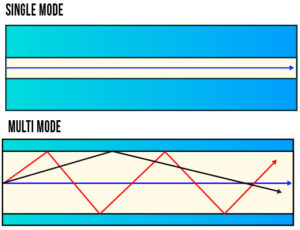
Multi-mode fibre optic has a wider core which allows multiple frequencies of light transmitted simultaneously (hence multi). As there are more signals transmitted at once multi-mode is faster than single-mode, but has higher attenuation therefore works over shorter distances (2km max).
In real world scenarios twisted pair is for short run (less than 100metres) connections where there is little or no electrical interference as it is cheaper. Connecting computers to switches in offices is ideal. Multi-mode fibre is for greater than 100 metre distances at very high speeds (10Gbps for example). Connecting one building to another building in a campus is ideal. Single-mode is for greater than 2km distances, connecting a business to an ISP (Internet Service Provider) for example.
Wireless
802.11x
802.11x is more commonly known to us as WiFi, however, use 802.11x in answers. The x is an indicator that the standard has many versions. We currently use 802.11ac as the fastest version, but faster standards will be released in future. Most 802.11x versions operate on 2.4Ghz and 5Ghz frequencies. 2.4Ghz generally is slower, but goes further and is less prone to interference. 5Ghz is generally faster, travels less distance and is more prone to interference. Interference can take the form of eletro magnetic (such as a microwave or kettle), physical such as walls, people, and plants, and other radio signals (other wireless devices). 802.11x should be used when a physical transmission media is not appropriate – such as the need to move around or cables are inaccessible. 802.11x works between 30 – 100 metres, but as mentioned is affected by its environment, so only expect 100m outside. Some versions will work beyond 100m, but as with all transmission media, there is attenuation of signal strength.