Rotation Cipher (Caesar Cipher)
- Each letter in the message is shifted a fixed number of places down the alphabet (e.g. shift of 3: A→D, B→E).
- Weakness: Only 25 possible shifts, so easily broken by brute force or frequency analysis (checking which letters appear most often).
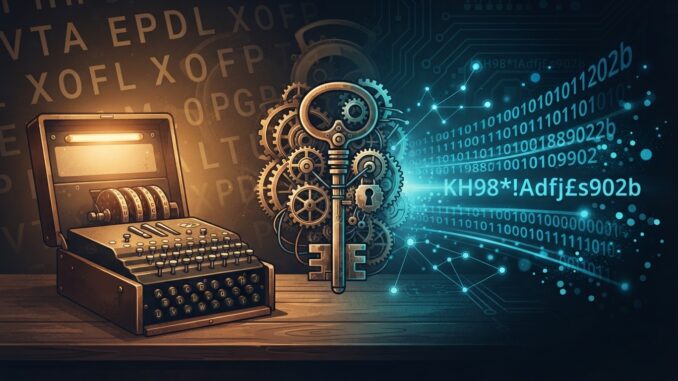
Enigma (Mechanical)
- A mechanical/electromechanical cipher machine used by Germany in WWII.
- Used a series of rotating wheels (rotors) and a plugboard to substitute letters, with the substitution pattern changing with every keystroke.
- Settings (rotor order, starting positions, plugboard connections) were changed daily, giving billions of possible combinations.
- Weakness: Despite its complexity, it had structural flaws (e.g. a letter could never encrypt to itself) and predictable operator habits, which codebreakers exploited to crack it.
RC4 (Rivest Cipher 4)
- A symmetric stream cipher (encrypts data bit-by-bit/byte-by-byte rather than in fixed blocks) once widely used, including in WEP (Wired Equivalent Privacy) and early WPA.
- Fast and simple to implement.
- Weakness: Statistical biases in its output made patterns detectable, and weak key scheduling meant that in cases like WEP, keys could be recovered. Now considered insecure and deprecated in modern protocols.
DES (Data Encryption Standard)
- A symmetric encryption algorithm developed in the 1970s, using a 56-bit key to encrypt data in 64-bit blocks. It was once the U.S. government standard,
- Weakness: its short key length makes it vulnerable to brute-force attacks with modern computing power – it can now be cracked in hours. Considered obsolete and insecure today, largely replaced by AES.